
TenantCluster
The resource that describes the lifecycle of one virtual Kubernetes tenant.
A TenantCluster represents a single virtual Kubernetes tenant. It references an
IsolationProfile and a SyncPolicy, and it describes how the tenant’s control
plane should run.
Example
apiVersion: tenantplane.io/v1alpha1
kind: TenantCluster
metadata:
  name: dev
  namespace: team-dev
spec:
  mode: shared
  kubernetesVersion: v1.30.4
  isolationProfileRef:
    name: restricted
  syncPolicyRef:
    name: default
  controlPlane:
    replicas: 1
    datastore:
      type: sqlite
  networking:
    egressPolicy: deny-by-default
  migration:
    allowModeChange: true
  resources:
    cpu: "2"
    memory: 2Gi
Key fields
| Field | Description |
|---|---|
mode | shared, dedicated, or private. Only shared is implemented; other modes are accepted and reconciled as shared with a condition explaining so. |
kubernetesVersion | Requested tenant Kubernetes version. Accepted today but not yet wired to k3s image selection. |
isolationProfileRef.name | The IsolationProfile applied around this tenant. |
syncPolicyRef.name | The SyncPolicy governing resource sync. |
controlPlane.replicas | Control-plane replicas. The current milestone supports a single replica. |
controlPlane.datastore.type | Datastore backend. Only sqlite is implemented. |
resources.cpu / resources.memory | Caps applied to the control plane and, when the profile requires it, to the tenant’s ResourceQuota. |
Status
The controller reports progress on .status:
phase—Pending,Provisioning,Ready, orDegraded.endpoint— the in-cluster HTTPS address of the tenant API server, once Ready.conditions— includingReady,Synced, andModeSupported.
kubectl get tenantcluster dev -o jsonpath='{.status.phase}{"\n"}'
kubectl describe tenantcluster dev
Lifecycle
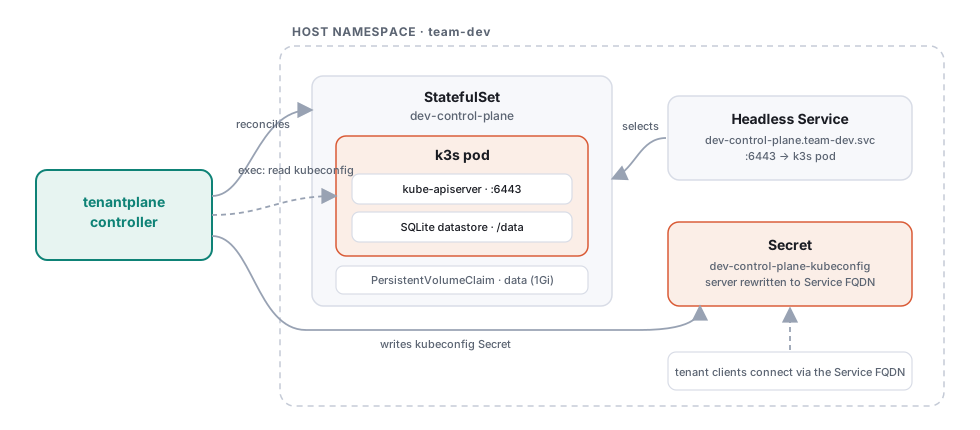
When you apply a TenantCluster, the controller:
- Resolves the referenced IsolationProfile and SyncPolicy (degrading if either is missing).
- Applies the isolation boundary to the namespace.
- Reconciles the headless Service and the k3s StatefulSet.
- Waits for the control-plane pod to become ready, then extracts its kubeconfig into a Secret.
- Runs a sync pass and sets the
Syncedcondition.
Deleting the TenantCluster garbage-collects the objects it owns (Service, StatefulSet, Secret, and namespaced isolation objects) via owner references.
Found a gap? Open an issue or PR.